Thin Mattress, Deep Sleep: What Asia's Bare-Bones Rooms Know That Marriott Doesn't
Let's be honest about something: American hotel culture is kind of exhausting. You check in, you're handed a keycard the size of a credit card, and then you spend the next twenty minutes adjusting the thermostat, figuring out which of the six pillows you actually want, and silently resenting the blackout curtains that don't quite meet in the middle. The bed is enormous. The thread count is astronomical. And somehow, at 3 a.m., you're still awake, staring at the ceiling of a room that cost you $350 a night.
Then you spend a week in a Kyoto machiya — one of those narrow, centuries-old townhouses converted into a guesthouse — sleeping on a futon laid directly on tatami, a single thin blanket, no pillow-top mattress in sight. And you sleep like you haven't slept since childhood.
What is going on?
The Abundance Trap
The American hospitality industry has spent decades operating on a very specific logic: more equals better. More square footage. More thread count. More climate control. More amenity options. The assumption is that comfort is a quantity — something you can stack up like towels on a rack until the guest feels sufficiently cared for.
But neuroscience is starting to complicate that story. Research on sensory load and sleep quality suggests that environments with excessive stimulation — even pleasant stimulation — keep the brain in a low-grade state of alertness. That hum of the HVAC system cycling on and off. The ambient glow from the charging ports. The slight chemical smell of laundered synthetic fabrics. None of it is unpleasant, exactly. But none of it is quiet, either.
The brain, it turns out, doesn't power down in rich environments. It monitors them.
What a Tatami Room Actually Does to You
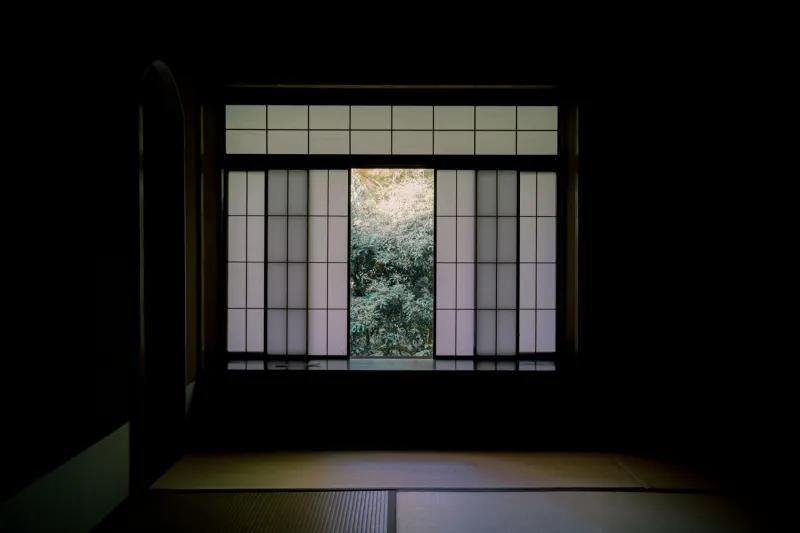
Step into a traditional Japanese guesthouse room and the first thing you notice is what's missing. There's no desk loaded with branded stationery. No minibar humming in the corner. No television mounted at eye level. Just a low table, a folded futon waiting to be laid out, maybe a single scroll painting on the wall. The room smells faintly of rush grass — that clean, slightly earthy scent of fresh tatami.
That smell isn't incidental. Tatami is made from igusa rush, which has been shown to have mild calming properties. The firmness of a traditional futon on a hard floor encourages spinal alignment in a way that a pillow-top mattress — which lets the body sink unevenly — often doesn't. And the low ceiling and compact dimensions of a machiya room create what designers call an "enclosure effect," a sense of being held rather than lost in space.
Sarah K., a graphic designer from Portland who spent three weeks in Kyoto last spring, described it this way: "I kept waiting to feel uncomfortable. I'm a side sleeper, I have a whole routine at home with like four pillows. But I woke up that first morning and I genuinely didn't know where I was for a second — not because I was disoriented, but because I'd slept so deeply I'd lost track of time."
Southeast Asia's Homestay Secret
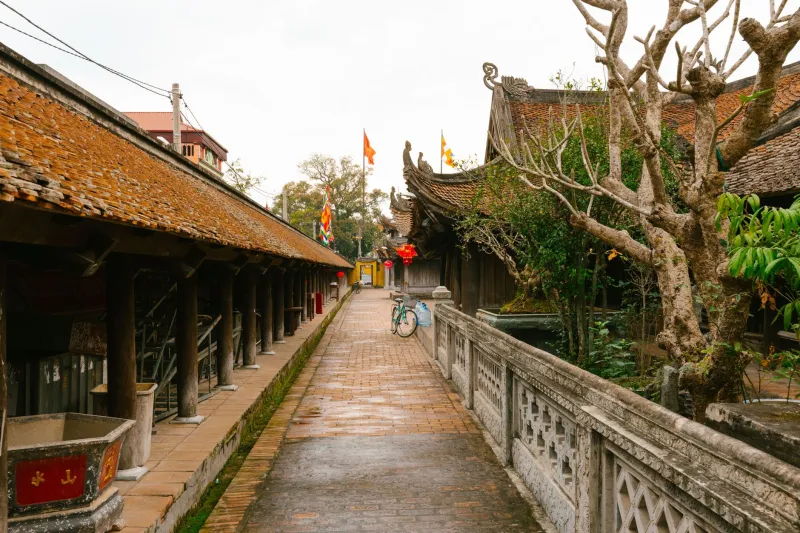
It's not just Japan. Travelers who've stayed in family-run guesthouses in northern Thailand, rural Vietnam, or the quieter islands of the Philippines report similar experiences. These aren't luxury eco-resorts with infinity pools and curated playlists. They're often simple rooms with a ceiling fan, a wooden bed frame, a cotton sheet. Windows that open to actual air rather than recycled, climate-controlled approximations of it.
That natural airflow matters more than people realize. A 2019 study published in Indoor Air found that sleeping in environments with natural ventilation — even in warmer temperatures — was associated with longer sleep duration and fewer nighttime awakenings than sleeping in sealed, air-conditioned rooms. The body, it seems, knows the difference between real air and manufactured comfort.
There's also something to be said for the acoustic environment. A ceiling fan in a Thai homestay produces a consistent, low-frequency white noise that sleep researchers consider genuinely conducive to rest. Compare that to the irregular cycling of a hotel HVAC system, which creates intermittent noise that the brain registers as unpredictable — and therefore worth monitoring.
The Psychology of Enough
Beyond the physical mechanics, there's something psychological happening in these simpler spaces. When you walk into a hotel room with a pillow menu, you're implicitly being told that your preferences matter enormously, that your comfort is a complex negotiation requiring multiple variables. That's not relaxing. That's a task.
When you walk into a tatami room, the message is different. Here is what there is. It is enough. There's a kind of relief in that. The decision-making stops. You don't have to optimize anything. You just... arrive.
James T., a financial consultant from Chicago who travels to Southeast Asia twice a year for work, says he stopped booking business hotels for his personal trips after a last-minute stay at a family guesthouse in Chiang Mai. "I had a meeting the next morning and I was stressed. The room was tiny, the bed was firm, there was one lamp. I thought I'd have a terrible night. I was asleep by nine and I didn't move until six. I've been chasing that ever since."
What This Doesn't Mean
None of this is an argument that discomfort is inherently virtuous, or that you should seek out bad accommodations in the name of authenticity. The best guesthouses in Kyoto and across Southeast Asia are thoughtfully maintained, scrupulously clean, and run by hosts who take genuine pride in what they offer. The simplicity is intentional, not neglectful.
And it's worth noting that what reads as "minimalist" to an American traveler is simply normal to the families who designed these spaces. They weren't trying to create a wellness experience. They were just building rooms the way rooms have been built for generations — proportioned to the human body, furnished with what's necessary, opened to the natural world rather than sealed against it.
The paradox is that in trying to optimize sleep with every conceivable amenity, American hotel culture may have engineered its way around the thing it was trying to provide.
The Souvenir You Didn't Expect
Travelers returning from extended stays in Asia often mention sleep as one of the things they miss most — not the sights, not even the food, but the particular quality of rest they found in a thin-walled guesthouse with a futon and a paper screen. Some of them come home and buy tatami mats. Others just start sleeping with the window open.
It's a funny thing to bring back from a trip. Not a piece of pottery or a bottle of sake, but the memory of what it felt like to lie down in a simple room and be, without effort or optimization, completely at ease.
Maybe that's the whole point. Maybe the best thing Asia's quietest rooms are offering isn't a product at all — it's a reminder that your body already knows how to rest. It just needs the right kind of nothing to do it.