Alone in the Best Way: What Solo Travelers Keep Finding in Asia's Quiet Corners
Nobody Told You About This Part of the Trip
There's a moment that keeps coming up in conversations with solo travelers who've spent real time in Asia. It's not at the famous shrine on a Tuesday morning or at the rooftop bar with the skyline view. It's somewhere smaller — a plastic stool at 11pm in Chiang Mai, or a gravel path outside a Kyoto neighborhood temple before the tourists arrive. Someone hands you something to eat, or nods in a way that needs no translation, and you think: this is what I came for.
American travelers have long treated Asia as a destination for self-discovery, but the script for that journey has gotten a little tired. The meditation retreat, the cooking class, the guided temple walk — all fine, genuinely fine — but a growing number of solo travelers are quietly opting out of the structured experience and finding something harder to manufacture: actual belonging.
The Case for the Overlooked Temple
Kyoto has more than 1,600 temples. Most visitors see the same eight. That's not a criticism — Kinkaku-ji and Fushimi Inari are famous for good reason. But the temples that don't make the top-ten lists operate on a completely different social frequency.
Small neighborhood temples — the kind tucked behind a convenience store or accessible only by a path that isn't on Google Maps yet — tend to attract the same cluster of locals every morning. Elderly residents who've been showing up for decades. A monk who sweeps the same stones the same way every day. Occasionally, a solo traveler who wandered off the main road and didn't immediately wander back.
What happens in those spaces is low-key and genuinely unremarkable by any external measure. Someone might gesture toward the incense holder to show you what to do. A conversation might start in broken English and trail off into comfortable silence. You don't leave with a story you can easily tell at a dinner party. You leave with something quieter, and it tends to stick.
For solo travelers specifically, this kind of unscripted encounter hits differently than it might for someone in a group. When you're traveling alone, you're more porous — more available to whatever's actually happening around you, because you're not managing anyone else's experience.
Night Markets as Accidental Community Centers
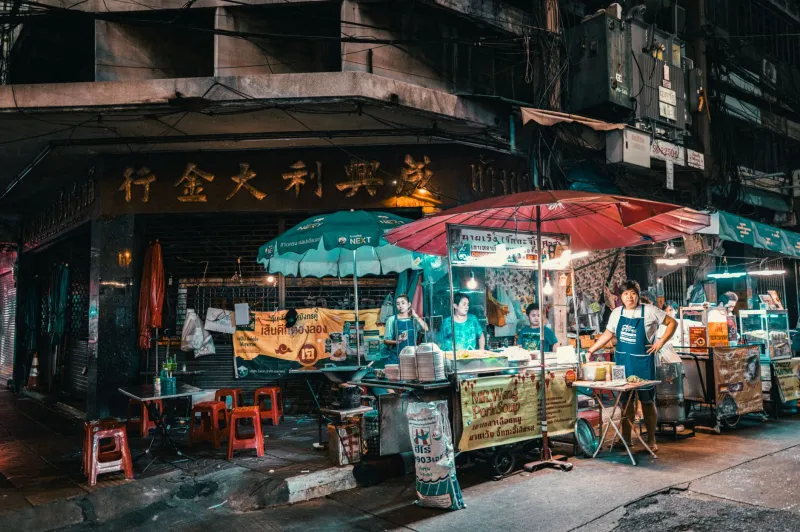
The same logic applies at the other end of the clock. Southeast Asia's night markets — in Penang, Hanoi, Luang Prabang, and dozens of smaller cities that don't get the magazine coverage — are not primarily tourist attractions. They're neighborhood infrastructure. Vendors who've worked the same stall for twenty years know each other's kids. Regulars show up at the same time every week. There's a whole social world running parallel to the tourist experience, and if you're alone and unhurried, you can sometimes slip into the edge of it.
This doesn't mean performing a fantasy of going native or pretending you're not a visitor. It means something simpler: ordering the same thing twice, coming back the next night, making eye contact instead of staring at your phone while you eat. The vendors notice. The regulars notice. And slowly, incrementally, you stop being a passerby.
American solo travelers in particular tend to underestimate how readable their openness is to people who interact with tourists every day. The difference between someone rushing through with a camera and someone who sat down and actually ate — that distinction is obvious, and it changes how you're treated.
Why Group Tours Can't Replicate This
Group tours are not the enemy. They're genuinely useful for first-time visitors, for people with limited time, for anyone who wants context provided rather than hunted for. But they create a specific social bubble that's hard to pop. You're always, to some degree, experiencing the destination as a group of Americans experiencing the destination. The local world is on the other side of a thin but real membrane.
Solo travel dissolves that membrane, sometimes uncomfortably. You have to figure out where to eat without a guide pointing you somewhere. You have to sit with the awkward silence of not knowing what's happening around you. You have to be wrong about things and recover without anyone to commiserate with.
That friction is exactly the point. It's what makes the small moments of connection feel earned rather than arranged.
Redefining What 'Finding Yourself' Means Over There
The phrase "finding yourself" has taken on a slightly ironic edge in American travel culture — conjuring images of expensive retreats and Instagram captions about transformation. But strip away the packaging, and there's something real underneath it. Travel does change how you see yourself, when it's working.
What solo travelers are increasingly reporting from Asia's quieter corners is less about dramatic personal revelation and more about something subtler: the experience of being genuinely anonymous and then, slowly, not being anonymous anymore. Of being absorbed, even briefly, into the rhythm of a place that was doing just fine before you arrived and will continue to do just fine after you leave.
That's a different kind of self-discovery. It's less about what you find inside yourself and more about what you find yourself capable of — patience, presence, the willingness to not be the main character for a while.
The smallest temples in Kyoto and the most unglamorous night market stalls in Southeast Asia have been quietly offering this all along. You just have to show up alone and stay a little longer than feels comfortable.
That's the whole trick, really.