Slow Down, You're Moving Too Fast: The Case for Walking Asia's Cities Like You Actually Live There

Photo by Photo by ayumi kubo on Unsplash on Unsplash
Let me describe two ways to spend a morning in Kyoto.
Option one: You've got a tour booked. Fushimi Inari at 8 a.m. before the crowds, then a taxi to Arashiyama, lunch at a place that's been recommended by every travel app you've downloaded, afternoon at Gion. You'll hit everything. You'll have the photos. By 6 p.m., you'll be exhausted in a way that feels productive.
Option two: You walk out of your guesthouse with no particular plan and turn down a side street you haven't been down before. You follow it because there's a smell you can't identify and you want to find out what it is. You end up watching an older woman arrange flowers in a doorway for twenty minutes because she starts talking to you and you don't want to be rude. You find a coffee shop in a converted machiya that isn't on any list. You get mildly lost. You find your way back.
Option two is a better morning. I'm not going to argue about this.
The Tyranny of the Itinerary
American travel culture has a productivity problem. We've imported our workplace logic — maximize output, minimize wasted time, measure success in completed tasks — directly into our vacations. The result is a style of travel that looks, from the outside, a lot like a very scenic commute.
Destination apps have made this worse in some ways, because they're fundamentally designed around the idea that a place can be fully represented by a list of its most photographed locations. You pin the spots, you navigate between them, you check them off. The map turns green. You "did" the city.
Except you didn't, really. You visited its most compressed, most curated, most tourist-facing surfaces. Which is fine — those places are often great. But it's not the same as actually inhabiting a place, even briefly.
The cities that reward slowness most generously — Kyoto, Chiang Mai, Hoi An, Luang Prabang, George Town in Penang — are the ones that have been storing stories in their side streets for centuries. Those stories don't appear on any app. They require feet.
What Street-Level Geography Actually Tells You
When you walk through Kyoto's Nishiki neighborhood slowly enough, you start to notice things that don't register at any other speed. The way certain shops have been in the same family for four generations, evidenced by the worn-smooth wooden threshold and the faded but carefully maintained signage. The way the street narrows at a specific point because of a property dispute that probably happened before anyone currently alive was born. The way locals navigate the tourist crowds with a practiced, unhurried efficiency that's almost choreographic.
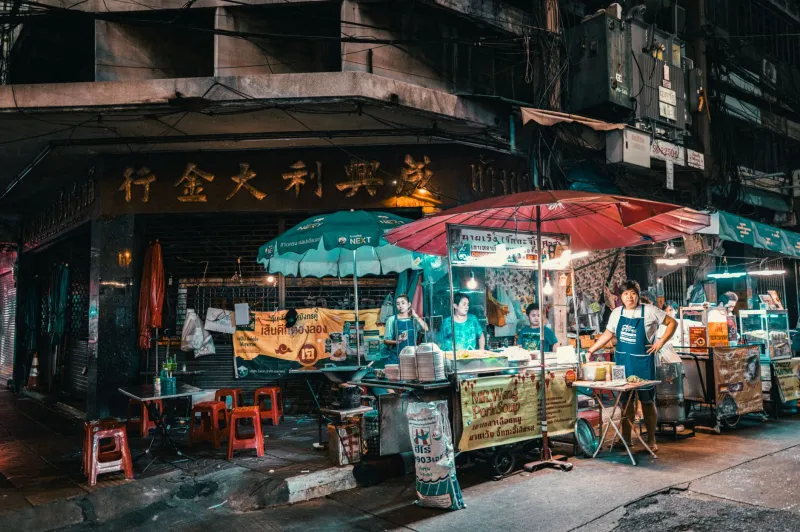
In Bangkok's older neighborhoods — Banglamphu, Talat Noi, the streets around the old Portuguese quarter — the same principle holds. The city's history is written in its street-level textures: the shrine tucked between two shophouses that would be invisible from a tuk-tuk, the noodle vendor who's been in the same spot since 6 a.m. and will stay until he sells out, the way the architecture shifts from Chinese shophouse to colonial building to modern concrete within a single block.
None of this is dramatic. None of it would make a great Instagram caption. But it's the actual substance of what these places are, and it's only available at walking pace.
How to Plan a Route That Lets You Get Lost on Purpose
This sounds like a contradiction, but it's not. The goal isn't to wander aimlessly — that can be exhausting in its own way, especially in a city where you don't speak the language and the streets don't follow a grid. The goal is to create a loose structure that leaves room for detours.
Here's what actually works:
Start with two anchors, not ten. Pick a starting point and a general ending point — maybe a neighborhood you want to explore and a restaurant you've actually decided to go to for dinner. Leave everything in between open. This gives you a direction without a schedule.
Walk toward what interests you, not toward what the map highlights. If you hear music, follow it. If a street looks more interesting than the one you're on, take it. The map is a suggestion, not a contract.
Give yourself permission to stop. This sounds obvious but it isn't, because American travel instinct is to keep moving. Sitting at a streetside coffee stall for forty-five minutes watching a Chiang Mai morning market operate is not wasting time. It's the entire point.
Learn one or two words in the local language before you go. Not a whole phrase book — just enough to signal that you're paying attention. In Japan, sumimasen (excuse me) and a genuine attempt at arigatou gozaimasu will open more doors than any translation app. In Thailand, a sawasdee with a small bow does something similar. People respond differently to travelers who are clearly trying.
Eat where there's no English menu. This is slightly terrifying the first time and completely fine every time after that. Point at what looks good. Accept what arrives. It's almost always excellent.
The Night Market as a Walking Meditation
Southeast Asia's night markets deserve their own mention because they represent a specific kind of walking experience — dense, sensory, slightly overwhelming — that has no real American equivalent.
The markets in Chiang Mai, in Luang Prabang, along Penang's streets on a Friday night: these aren't shopping destinations, exactly, even though you'll probably buy something. They're community spaces that happen to be organized around commerce. Families are there. Older couples are there. Kids are running between the stalls. The food vendors are competing and also clearly know each other.
Walking through one of these markets slowly — not with a mission, not with a list of things to try — and just letting it wash over you is a genuinely different experience than any other kind of tourism. You're not observing the place. You're briefly inside it.
What You Actually Bring Home
The checklist approach to travel produces a certain kind of memory: crisp, well-documented, easily shared. The slow approach produces something harder to photograph but more durable — a sense of what a place actually feels like from the inside, a handful of small encounters you didn't plan for, a recalibrated sense of what it means to be somewhere.
That recalibration tends to follow you home. After a week of walking Kyoto at the pace it was designed for, the idea of rushing through your own neighborhood without looking at it starts to feel like a waste. After a few nights in a Southeast Asian night market, the idea that a destination can be "done" in an afternoon seems almost comically reductive.
The cities are patient. They've been there for centuries and they'll be there after the apps update and the tour buses move on. Walk slowly. They'll show you what they've got.